Dyson against Shark
Quick answer
The Dyson V15 Detect Plus (under $1,000) is rated at 240 air watts with a 60 minute eco runtime and a laser dust illumination feature. The Shark PowerPro Flex Pet Plus IZ388H (under $300) carries HEPA filtration with an anti-allergen complete seal and up to 50 minutes of runtime at less than a third of the price. Neither is wrong: the Dyson buys motor headroom and diagnostics, the Shark buys certified filtration at a lower entry cost.
Published manufacturer specifications, plus service and repair conventions where noted.

Shark PowerPro Flex Pet Plus Cordless Vacuum, Tea Green, IZ388H
For most households the Shark PowerPro Flex Pet Plus is the more defensible buy: it carries HEPA filtration with a sealed air path, costs less than a third of the Dyson, and covers the same daily floor cleaning job. The Dyson earns its price only when the buyer specifically wants the highest published air watt rating and the particle sensor screen.
The two sides
- Dyson
Dyson lists 240 air watts on the V15 Detect Plus, the highest published air watt figure in its current cordless stick lineup.
Under $1,000 Check priceBudget band; Amazon shows the current price - Shark
Shark PowerPro Flex Pet Plus Cordless Vacuum, Tea Green, IZ388H
The Shark PowerPro Flex Pet Plus IZ388H lists HEPA filtration with an anti-allergen complete seal, a spec Dyson does not publish for the V15 Detect Plus.
Under $300 Check priceBudget band; Amazon shows the current price

| Factor | Dyson V15 Detect Plus | Shark PowerPro Flex Pet Plus IZ388H |
|---|---|---|
| Budget | Under $1,000 | Under $300 |
| Air watts (published) | 240 AW | Not published |
| Rated runtime (longest published) | 60 minutes (eco mode) | Up to 50 minutes (standard mode, at the handvac) |
| Sealed HEPA filtration | Not listed | Listed |
| Format | Cordless stick, converts to handheld | Cordless stick, converts to handheld |
| Typical service life | 4 to 7 years | 4 to 7 years |
Why the Dyson costs so much more for a shorter runtime on paper
Air watts measure the work a vacuum head actually does, combining airflow and suction pressure at the cleaning head rather than at a sealed inlet. Dyson publishes 240 air watts for the V15 Detect Plus, which is the top of its own current cordless lineup. That figure is not directly comparable to Shark's pascal or wattage claims on other models, since air watts and pascals measure different things and there is no valid conversion between them.
The rest of the V15 Detect Plus price covers the laser illumination head that lights up fine dust on hard floors and the onboard particle counter, not the motor alone. Those are genuinely unique features in this comparison, but they are cosmetic and diagnostic rather than cleaning power in themselves.
Why the Shark is the harder value to beat
The Shark PowerPro Flex Pet Plus IZ388H lists HEPA filtration with an anti-allergen complete seal, rated by Shark to trap over 99.97 percent of particles 0.3 microns and larger, which the Dyson V15 Detect Plus does not carry in its published specification. For a household managing dust allergies or pet dander, a sealed HEPA stage is a concrete, checkable spec rather than a marketing claim, and it is present on the cheaper machine in this pairing.
At about a third of the price of the Dyson, the Shark also leaves more budget for a spare battery, replacement filters or a second machine for stairs. Its up to 50 minute rating is shorter on paper than the Dyson, but most single-floor apartments and small homes finish a full clean well inside that window. It also adds a wand that bends to reach under furniture and a brushroll that adjusts to the floor type.
What runtime numbers actually mean
Both figures above are the longest runtime each brand publishes: Dyson rates eco mode, Shark rates standard mode measured at the handvac, so neither is a floor-head figure. Boost or max power modes on cordless sticks typically run three to four times faster through the battery, so a real cleaning session that uses higher power on carpet will draw down faster than the headline number suggests on either machine.
A question people actually ask: does higher air watts always mean a cleaner floor?
Not on its own. Air watts describe motor and airflow performance at the head, but carpet cleaning also depends on brush roll design, how well the head seals against the floor, and bin or filter loading over the course of a clean. A lower air watt machine with a well sealed head and a clean filter can outperform a higher air watt machine running on a clogged filter. Since bagless cordless sticks have no bag wall to help filter incoming air, both of these machines depend on their internal filter staying clean to hold their rated numbers.
- Check filter condition regularly, since a clogged filter drops suction on any cordless stick regardless of its rated air watts.
- Match power mode to floor type: eco for light daily upkeep, boost for embedded carpet debris.
- A HEPA-rated filter only performs to spec when the whole air path is sealed, not just the filter element itself.
Pick the Dyson V15 Detect Plus if the household wants the highest published air watt figure in its class and finds real use for the dust illumination and particle counter. Pick the Shark PowerPro Flex Pet Plus IZ388H if a sealed HEPA filter matters more than headline power, or if the budget is better spent on a spare battery or a second vacuum for another floor. Neither is a universal winner: they are built for different priorities.
Others in this category
An even spread across the price range.
- RONEAIR
RONEAIR Cordless Vacuum Cleaner 40Kpa 45Min 6-in-1 Self-Standing
Under $100 Check priceBudget band; Amazon shows the current price - Levoit
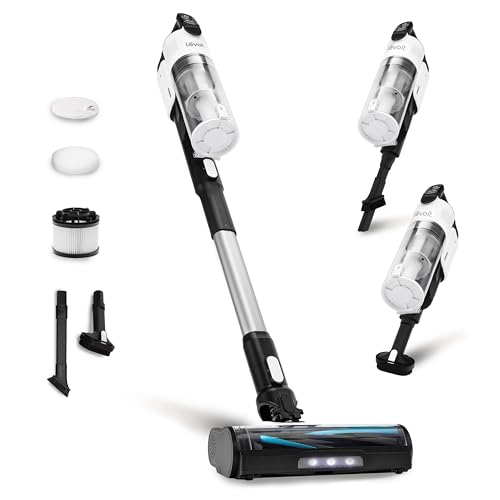
Levoit Cordless Vacuum Cleaner, Anti-Tangle for Pet Hair, Up to 50 Minutes
Under $200 Check priceBudget band; Amazon shows the current price - Shark
Shark Pet Cordless Stick Vacuum, Ice Blue, IX141AMZ
Under $200 Check priceBudget band; Amazon shows the current price - Dyson
Dyson V15 Detect Cordless Vacuum
Under $1,000 Check priceBudget band; Amazon shows the current price



Common questions
Is the Dyson V15 Detect Plus worth more than three times the price of the Shark PowerPro Flex Pet Plus?
Only if the laser dust illumination head, the onboard particle counter, and the 240 air watt rating matter to you specifically. For everyday floor cleaning without those extras, the Shark covers the same job at a much lower price and adds a sealed HEPA filter the Dyson does not list.
Can I compare Dyson air watts to Shark's suction numbers directly?
No. Air watts measure combined airflow and pressure at the cleaning head, while pascal or sealed suction figures measure pressure alone with the inlet blocked. There is no valid math to convert one into the other, so only compare air watts to air watts and pascals to pascals.
Does the Shark PowerPro Flex Pet Plus HEPA filter mean it is better for allergies than the Dyson?
It means the Shark lists a HEPA stage with an anti-allergen complete seal, which Dyson does not publish for this specific model. A sealed HEPA filter is a meaningful spec for allergy sufferers, but neither brand publishes an independent test of the whole machine in detail.
Which one runs longer on a single charge?
The Dyson V15 Detect Plus is rated for 60 minutes in eco mode against up to 50 minutes for the Shark PowerPro Flex Pet Plus, measured at the handvac in standard mode. Both figures drop substantially, roughly three to four times faster, once boost or max power is used on carpet.
Do both convert to a handheld vacuum?
Yes, both machines in this comparison are cordless stick vacuums designed to detach into a handheld unit for stairs, upholstery and car interiors, which is standard across this product category.
How long should either machine last before it needs replacing?
Cordless stick vacuums typically run 4 to 7 years of service life before battery degradation or motor wear makes replacement more sensible than repair, regardless of brand.
Every figure here comes from published manufacturer specifications, owner reported measurements and repair documentation, and each is labelled as either a standard or a convention. This is researched general information to help you diagnose and plan, not professional advice, and it cannot tell you what is wrong with one particular machine. Your own manual and the part number printed on your machine are the final word.