Roomba filters
Quick answer
Replacement filters listed as fitting Roomba machines run from $9.99 to $19.99, with 8 current listings. Confirm against the number printed on your own part before ordering, because a brand match is not a model match and Roomba uses different filters across its ranges.
Prices and fitment claims come from the listings themselves. The service intervals are conventions.
| Listing | Price |
|---|---|
| E-HAO Vac HEPA Filters for iRobot Roomba Essential/104/105/105x/Q/Y Series | $9.99 |
| 10 Pack 105 Filters Replacement for iRobot Roomba 105 Essential Series | $9.99 |
| 3 Pack Hepa Filter Filters Replacement For irobot Roomba 800 900 series 860 870 871 880 960 980 | $11.49 |
| Replacement Parts & Accessories for iRobot E, I & J Series, Combo i5, j5 Series Robot Vacuum, D | $12.99 |
| Replacement Filter for iRobot Roomba i,e,j Series Robot Vacuum Cleaners | $15.99 |
| I clean 10pcs Replacement iRobot Roomba Hepa Filter for 800&900 Series | $16.99 |
| Replacement Filter For iRobot Roomba Max 705 Vac Plus 504 Vac Robot Vacuum | $18.99 |
| iRobot® Authentic Replacement Parts - Filter for iRobot® Roomba® 105 & Essential series robots, | $19.99 |
Roomba filters
Shown across the price range rather than cheapest first, so the grid reflects the whole category.
- KEEPOW
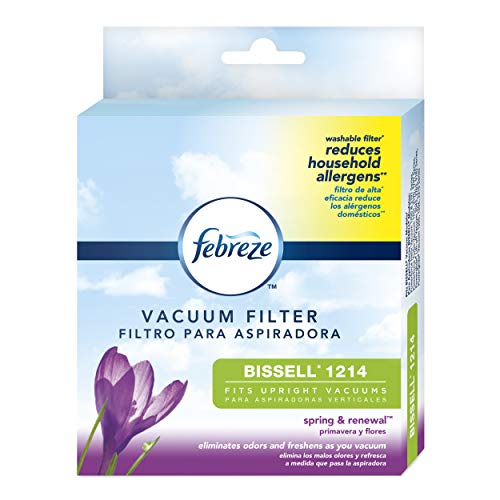
KEEPOW Vacuum Filters Compatible with Bissell Febreze Style 1214
$7.99 Check pricePrices change often - Cleangela
10 Pack 105 Filters Replacement for iRobot Roomba 105 Essential Series
$9.99 Check pricePrices change often - Bissell
BISSELL Febreze Style 1214 Cleanview & PowerGlide Pet Replacement Filter - 12141
$13.99 Check pricePrices change often - Hechuang
Filter for Dyson V8 Filter Replacement, Animal, Absolute Cordless Vacuum V7
$16.99 Check pricePrices change often




How to confirm a part fits before ordering
Take the old part out and read the number moulded or printed on it, then match that number against the listing rather than matching the brand. This is the step that goes wrong most often: Roomba sells several ranges that look similar from the outside and take entirely different filters, and a listing that names forty compatible models is telling you less than one that names three.
Where the old part has no readable number, the model number of the machine itself is on a plate, usually under the body or behind the bin. That number, not the marketing name on the front, is what a parts listing is keyed to.
What a filter actually does
It is the element that keeps the airflow clean and the motor cool. That is worth knowing because it tells you what a worn one costs you: a symptom rather than an outright failure, which is exactly why this part gets neglected until the machine is written off for something that was never wrong with it.
A loaded filter throttles airflow through the whole machine, and airflow is what carries dust into the bin. The motor is also cooled by the air it moves, so a blocked element means it runs hotter than designed for as long as the blockage lasts.
Genuine against third party
The thing to compare is the specification, not the brand on the box. A third party part that names the media grade, the dimensions and the specific models it fits is a different proposition from one that lists every model the manufacturer has ever made and gives no specification at all.
On a sealed filtration machine the fit matters as much as the media, because an element that seats badly leaks around its edge and the rating becomes meaningless. That is the case where a genuine part is most often worth its premium.
Common questions
How do I know which filter my Roomba takes?
Read the number on the old part, or the model number on the plate on the machine body, and match that against the listing. The marketing name on the front of the vacuum is not enough: Roomba runs several ranges that look alike from the outside and take completely different parts, and matching on brand alone is the most common way this goes wrong.
How much do Roomba filters cost?
Current listings run from $9.99 to $19.99, with 8 options showing. The spread is mostly genuine against third party and single against multipack, so compare the price per unit rather than the sticker, especially where a pack of several costs barely more than one.
How often should filters be replaced?
It depends far more on the household than the calendar. A foam pre-filter wants rinsing monthly and replacing yearly, while a sealed HEPA element is replaced every six to twelve months and never washed. Pets roughly halve both figures, and the filter schedule tool works the interval out for a specific household.
Are third party parts a false economy?
Not inherently, and the useful test is whether the listing states a specification. A part that names its media grade, its dimensions and the specific models it fits is worth considering at any price. One that lists dozens of compatible models with no specification at all is asking you to trust a claim it has not made concrete, and on sealed filtration machines a poor fit undoes the whole point.
Can I clean this part instead of replacing it?
Only if it is designed to be washed, and the filter itself or the manual will say. Foam and felt elements wash and last for years that way. Pleated and HEPA elements do not: water collapses the media permanently, and the filter dries looking fine while no longer capturing what it was rated for.
Every figure here comes from published manufacturer specifications, owner reported measurements and repair documentation, and each is labelled as either a standard or a convention. This is researched general information to help you diagnose and plan, not professional advice, and it cannot tell you what is wrong with one particular machine. Your own manual and the part number printed on your machine are the final word.