Best canister vacuums
Quick answer
The Miele Classic C1 Turbo Team ($391.21) is the strongest overall pick, pairing a Miele sealed bagged system with a turbo brush head for carpet at a price well below the top of the category. Budget shoppers should look at the Eureka 3670M ($82.99) for a lightweight bagged starter, while anyone who wants Miele's dedicated pet and deep-carpet configuration should look at the Miele Classic C1 Cat & Dog ($619.98).

Miele Classic C1 Turbo Team Vacuum for Hard Floors & Low-Med Pile Carpet
The Miele Classic C1 Turbo Team pairs a motorized turbo brush head, useful for carpet agitation, with Miele's bagged sealed system at $391.21, well under the $619.98 top-tier Cat & Dog configuration. It gives most of the Miele build quality and filtration benefit without paying for the pet-specific tooling that a household without pets does not need.
The three tiers
Beginner: Eureka 3670M
A small household or apartment that wants a light, low-cost bagged canister for carpet and hard floor.
The Eureka 3670M is a lightweight bagged canister that ships with 5 bags included, keeping the household stocked from the first day of use. Its lighter build makes it easier to carry between rooms and up stairs than a full-size canister. At $82.99 it is among the least expensive canister vacuums in the catalog.
Not for: A household that wants HEPA-level filtration or a large-capacity bag for infrequent emptying, since the published listing does not claim a sealed HEPA filter.
Intermediate: Kenmore 600 Series Pet Friendly Bagged Canister
A household with pets that wants HEPA filtration and a bagged system without stepping up to Miele pricing.- Intermediate pick
Kenmore 600 Series Pet Friendly Bagged Canister Vacuum
$289.99 Check pricePrices change often
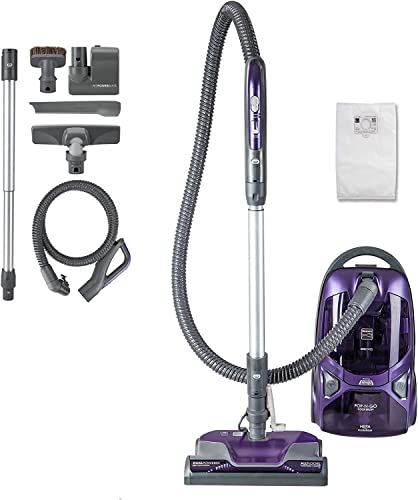
The Kenmore 600 Series lists HEPA filtration and a bagged design aimed specifically at pet hair pickup, which combines allergen control with the cleaner bag-disposal method over a bagless bin. At $289.99 it lands in the middle of the canister category, ahead of entry-level bagless models but well below the premium bagged brands.
Not for: Anyone who wants a bagless system to avoid the ongoing cost of replacement bags.
Expert: Miele Classic C1 Cat & Dog
Buyers who want Miele's dedicated pet and deep-carpet configuration and are willing to pay flagship price for it.- Expert pick
Miele Classic C1 Cat & Dog Bagged Canister for Deep Carpet Cleaning
$619.98 Check pricePrices change often

The Classic C1 Cat & Dog is Miele's bagged canister configuration built specifically for deep carpet cleaning in pet-owning households, and Miele's bagged systems are widely used in allergy-focused settings for their sealed bag design that traps dust on disposal rather than releasing it. At $619.98 it is priced at the top of the canister category.
Not for: A household without pets or deep carpet needs, where the Turbo Team model in the top pick slot above delivers similar core cleaning at a substantially lower price.
| Model | Price | Filter | Bag type |
|---|---|---|---|
| Eureka 3670M | $82.99 | Not published | Bagged |
| Kenmore 600 Series Pet Friendly | $289.99 | HEPA | Bagged |
| Miele Classic C1 Turbo Team | $391.21 | Not published | Bagged |
| Miele Classic C1 Cat & Dog | $619.98 | Not published | Bagged |
Why bagged canisters remain common in this category
A bagged canister seals collected dust and allergens inside a disposable bag that is thrown away sealed, rather than emptied into an open bin. This tends to release less fine dust back into the room during disposal, which is a large part of why bagged systems remain the standard configuration across most models in this roundup, including every Miele and Kenmore listing above. The ongoing cost is buying replacement bags over the life of the vacuum, which should be weighed against the lower up-front price of a bagless model.
A turbo brush head matters more than the canister motor for carpet
Carpet is cleaned primarily through agitation from a driven brush roll, not through suction pulling dirt upward on its own. A canister vacuum paired with a turbo or motorized brush head, like the Turbo Team model in the top pick slot, will generally outperform a canister with only a suction-only floor tool on carpet, even at similar suction levels. A suction-only tool, sometimes called a "pure suction" head, is instead built for hard floors and low-pile rugs where agitation is less necessary and a stiff brush risks scattering debris rather than lifting it.
What "Cat & Dog" and similar pet configurations actually add
Pet-focused canister configurations, like the Miele Classic C1 Cat & Dog in the expert tier, typically add a dedicated upholstery or turbo tool designed for pet hair pickup on furniture and stairs, alongside the same core motor and filtration as the brand's standard configuration. The core cleaning performance on floors is usually similar to the non-pet configuration at a lower price; the added value is in the extra tooling for pet hair specifically, not a fundamentally different vacuum motor.
When a canister is the wrong tool for the job
A canister vacuum is a corded, two-piece machine: a body that stays in one spot or gets dragged along, connected by a hose to the cleaning head. This makes it well suited to a mix of floor types and stairs where the flexible hose reaches into tight corners, but it is less convenient for quick daily touch-ups than a cordless stick, and it does not offer the hands-off maintenance cleaning a robot vacuum provides between deeper cleaning sessions.
How we chose
We have not tested any of these vacuums in person. Every filter, bag type, and configuration claim above comes directly from the manufacturer specifications published on the Amazon listing for that exact ASIN.
Where a listing did not state a specific suction or filtration figure, we said plainly that the figure was not published rather than estimating one.
We selected one model from the bottom of the canister price range, one from the middle, and one at the very top, rather than clustering all three in a single price band.
Turbo brush and pet-tooling claims reflect what each manufacturer states about that specific configuration, not our own side-by-side comparison of the machines.
Buying tips
Decide between a turbo head and a pure-suction head based on flooring
A turbo or motorized brush head suits carpet agitation; a pure-suction head suits hard floors and delicate low-pile rugs where a spinning brush risks scattering debris. Some canisters, like the Turbo Team model above, ship with both tool types.
Factor bag cost into the total price over several years
A bagged canister has a lower ongoing mess but an ongoing bag cost that a bagless model avoids. Check the price and availability of replacement bags for a specific brand before assuming the lowest up-front price is the lowest total cost.
Check the hose length and reach before buying for a multi-room home
A canister's hose and wand length determines how far it can reach without repositioning the main body, which matters more in homes with stairs or large rooms than in small apartments.
Do not assume a pet-specific configuration cleans better on floors
Pet-focused configurations mainly add specialized upholstery or turbo tooling for hair pickup on furniture, not a different core vacuum motor. A household without pets can often get comparable floor performance from the brand's standard configuration at a lower price.
Other options across the price range
An even spread from the bottom to the top of the category, not the six cheapest.
- Miele
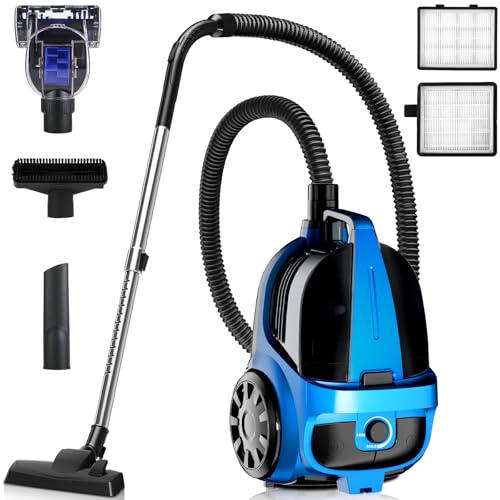
Miele Classic C1 Pure Suction Vacuum for Hard Floors & Low-Pile Carpet
$316.00 Check pricePrices change often


Safety
Fine ash and drywall dust can clog a standard filter and, with hot ash specifically, create a fire risk inside the bag or bin. Use a dedicated ash vacuum or sweep these materials by hand instead.
Common questions
Is a bagged canister vacuum better than a bagless one?
Neither is universally better; they trade off differently. A bagged canister tends to contain more fine dust during disposal because the bag is sealed and thrown away, which many allergy-sensitive households prefer, but it carries an ongoing cost for replacement bags. A bagless canister avoids that recurring cost but requires emptying and sometimes rinsing a canister bin by hand.
What does a turbo brush head do on a canister vacuum?
A turbo brush head uses the vacuum's own airflow, or in some cases a small motor, to spin a brush roll that agitates carpet fibers and lifts embedded dirt, which suction alone cannot do as effectively. It is generally recommended for carpet and rugs, while a pure-suction head without a spinning brush is better suited to hard floors.
Do canister vacuums work well on stairs?
Yes, generally better than a full-size upright, because the lightweight hose and wand can be carried up the stairs while the heavier main body stays in place on a landing or lower step. This is one of the main practical advantages of a canister design over an upright.
How often should a canister vacuum bag be replaced?
This depends on household size, pet hair, and how often the vacuum is used, but most manufacturers recommend replacing a bag once it reaches roughly two-thirds full, since suction weakens as the bag fills. Check the specific model's bag capacity and the manufacturer's recommended replacement interval rather than waiting until the bag is completely full.
What is the difference between a pet-specific canister and the standard version of the same model?
A pet-specific configuration, such as a "Cat & Dog" or "Pet Friendly" model, typically adds specialized upholstery, turbo, or mini-tool attachments designed for pet hair on furniture and stairs. The core vacuum motor and filtration are usually the same as the brand's standard configuration, so the added value is mainly in the extra tooling rather than a different vacuum entirely.
Can a canister vacuum replace a robot vacuum for daily maintenance?
Not in the same role. A canister vacuum requires manual operation for each cleaning session and works well for scheduled, thorough cleaning across mixed floor types, while a robot vacuum runs on its own for lighter, more frequent maintenance cleaning. Many households use both: a robot for daily upkeep and a canister for periodic deeper cleaning.
Every figure here comes from published manufacturer specifications, owner reported measurements and repair documentation, and each is labelled as either a standard or a convention. This is researched general information to help you diagnose and plan, not professional advice, and it cannot tell you what is wrong with one particular machine. Your own manual and the part number printed on your machine are the final word.